Orchestration
One objective.Many agents.
Break a larger job into tasks, hand each one to an agent session on this machine or another, and step in only where a person should decide. Glueprint keeps track of what's ready, what's blocked and what came back.
- Coordinators
- Sessions · assistants · the CLI
- Workers
- Subagents · full sessions · other hosts
- Decisions
- Gates · question cards · inbox
Hand off a piece.Watch it come back.
Here the log search session splits off two subagents: one writes the tests while the other checks ordering, and the parent keeps working.
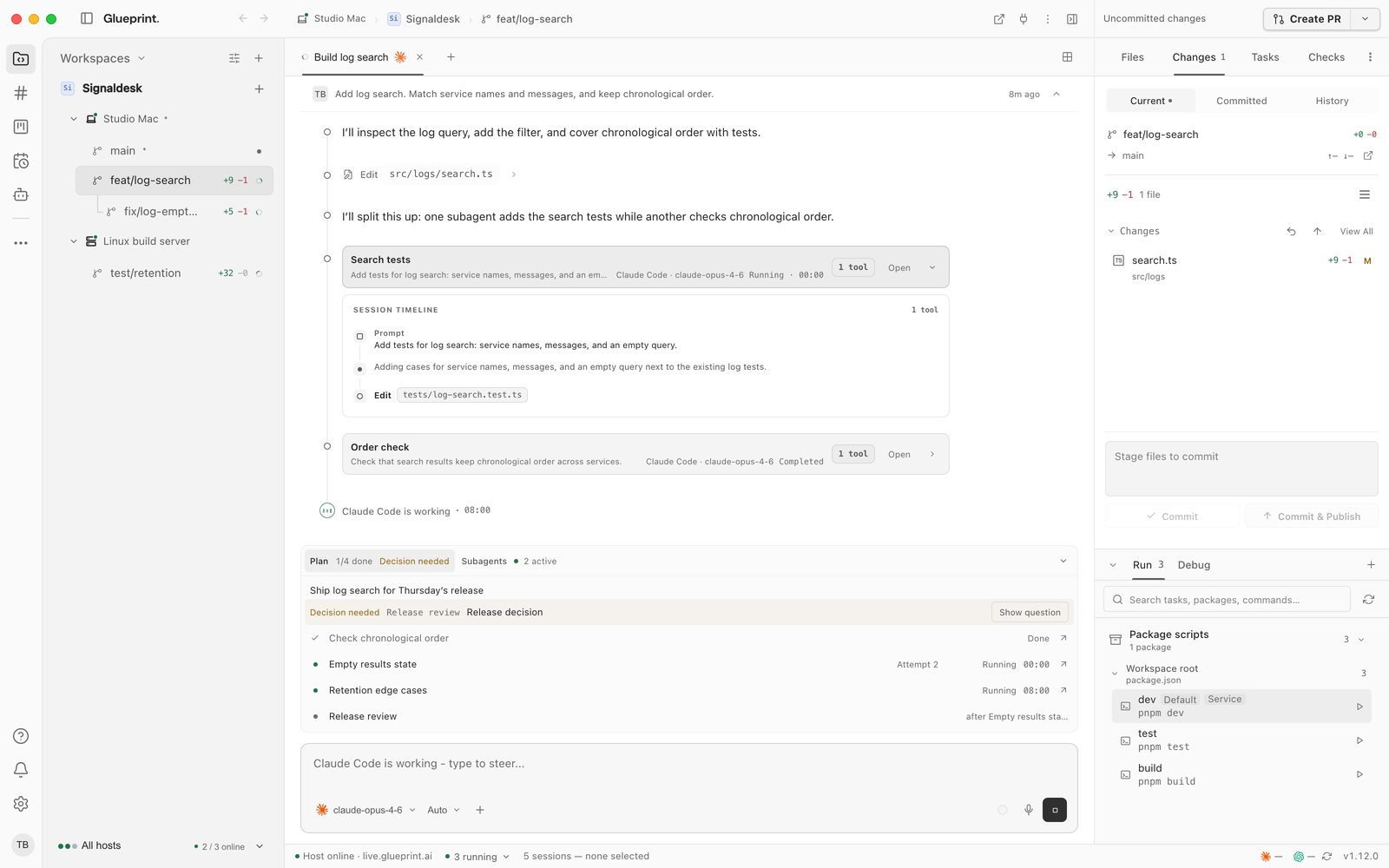
- 01A subagentA child session started from the conversation, with its task, agent, model and status.
- 02Its timelineExpand the card to follow the child's prompt, messages and tool calls in place.
- 03OpenOpen the child's full chat beside the parent to read it or answer its questions.
- 04A finished subagentWhen a child is done, its card says so and the parent picks up its result.
- 05The parent keeps goingThe coordinating session keeps working while its subagents run.
- 06Plan and subagentsThe run's plan and every child of this session, running or finished, above the composer.
Plan the work.Readiness follows.
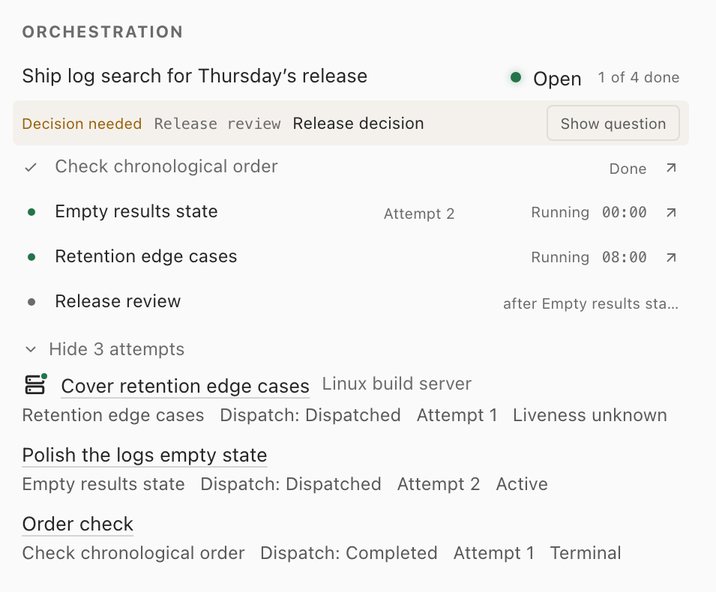
A run is one objective broken into tasks, with the dependencies between them. A task is ready when everything it depends on is done and no decision is pending. Glueprint works that out on every read and names exactly what's in the way.
- Each task shows its state and what's blocking it: another task, or a gate.
- Each worker shows its attempt and whether it's active, idle, waiting or stalled.
- A retry is a new attempt. The earlier result stays on record.
- If a failure leaves nothing able to move, the run says it's stuck, once.
Ask a person.At the real decision.
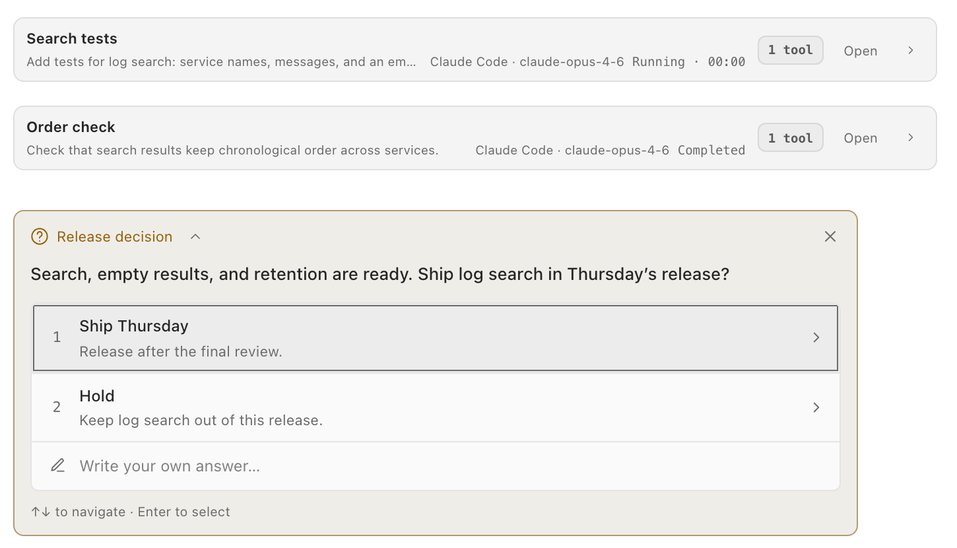
A decision gate holds one task until a person answers. It arrives as an ordinary question card on the coordinating session, and the rest of the run keeps moving while it waits.
- Offer preset answers, or let the reviewer write their own.
- Answering resolves the gate, and the task becomes ready once its other dependencies are done.
- Show question in Session info brings a pending gate back into view.
Anyone can run it.Even a script.
The same runs, tasks and gates work whether a session you started is coordinating, an assistant is, or a script on a server is.
-
01
A session you started
Ask the agent to split the work. It starts subagents in its own transcript, or full sessions in their own tabs, and reads what comes back.
gp_spawn_subagent · gp_create_session · gp_orch_* -
02
An assistant
An assistant coordinates the same way, within the delegation rules its role allows. What lands in its inbox can wake it.
gp_spawn_subagent · gp_start_session -
03
A script, with no session
Drive runs, tasks, workers, gates and the inbox from the glueprint command, with JSON output and fixed exit codes.
glueprint run create --objective … --auto-close
Workers anywhere.Recovery built in.
The run lives on the host that owns it, workers can run elsewhere, and the engine repairs what a crash or an outage leaves behind.
-
Inline subagents
A child session in the parent's transcript, on the same host, with its own agent, questions and permissions. Starting one needs no approval.
-
Workers on other hosts
A full session can run on another machine you've connected. The run stays home; the worker's reports travel back over the relay.
-
Reports that arrive
A worker's report is saved before it's sent and retried until the coordinator's host has it, so a relay outage only delays it.
-
Stalls noticed
A worker with no output, idle without reporting, or stuck launching for 10 minutes is flagged, and the coordinator is told.
-
Crash recovery
At startup and every 30 seconds, lost workers are settled, abandoned runs are closed and missed notifications are sent again.
-
Private tasks
A run's tasks never touch your boards. A run holds up to 200 of them and is kept for 30 days after it closes.
Workers on other hosts need a plan with cloud relay.
OR-600 Split the work
Give the big job a plan.Keep the last word.
Download Glueprint, start a session on something too big for one agent, and ask it to split the work.